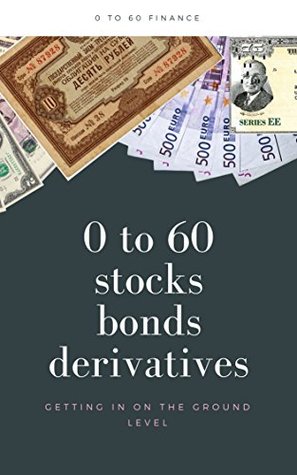
Download 0 to 60 Stocks, Bonds, and Derivatives (0 to Finance) - Hyun-Jeong Yoo | ePub
Related searches:
Stocks/Bonds 60/40 Portfolio: ETF allocation and returns
0 to 60 Stocks, Bonds, and Derivatives (0 to Finance)
Asset allocation and derivatives - Columbia University
Differences and Definitions of Stocks and Bonds
Sample Questions And Solutions Derivatives
The 60-40 rule for bonds and stocks may need rethinking as
The Proper Asset Allocation Of Stocks And Bonds By Age
Biden plans to impose 0.1% levy on stock, bond and derivative
Fixed Income and Interest Rate Derivative Analysis
Stock and derivatives market in india - SlideShare
Stocks vs Bonds - Difference and Comparison Diffen
Volatility and derivatives turnover: a tenuous relationship
Trading derivatives on the path to Financial Independence and
International Swaps and Derivatives Association
For example, let’s say widget stock is trading at $50 a share. You buy an option contract that gives you the right to buy it at $50 a share because you feel sure it is going to $60, but just in case it doesn’t, you don’t want to be out the full cost of $50 a share.
A call option on a stock) pays units, where is a random variable on the probability space describing the market. Further suppose that the discount factor from now (time zero) until time t \displaystyle t is p ( 0� t ) \displaystyle p(0,t)�.
Nov 29, 2020 no one doubts that the classic mix of 60% stocks and 40% bonds has done well in the past.
Stocks and bonds represent two different ways for an entity to raise money to fund or expand its operations. When a company issues stock, it is selling a piece of itself in exchange for cash.
In trillions of us dollars (left-hand scale) and percentages (right-hand scale).
Fundamentals of financial instruments: an introduction to stocks, bonds, foreign exchange, and derivatives [parameswaran, sunil] on amazon.
Compute the probability that stocks will underperform bonds for investment horizons of 1, 2, 5, 10, 20, and 30 years. Compute the corresponding var at the 5% level for those horizons. Compute the expected shortfall under those circumstances – or the expected value of the stock investment given that stocks underperform bonds.
Convertible debt is a hybrid instrument evidencing a borrowing that is convertible into some other instrument. Traditionally, the underlying instrument into which the debt is convertible is stock; however, the conversion really could be into any type of financial other than cash, including, among other others, derivative instruments, marketable securities, or other forms of debt.
Keywords: corporate bond mutual funds, derivatives, fund performance, investment grade. Funds most of the literature focuses on the impact of derivatives in equity funds.
A large number of financial institutions in asia-pacific are expected to be brought into scope read more use of rmb-denominated chinese government bonds as margin for derivatives transactions.
Derivative: claim whose payoff is a function of another's 30 40 50 60 70 stock price 0 4 8 12 16 20 30 40 50 60 70 consider portfolio of stocks and bonds.
Stock options are a form of derivative that is widely traded today. The term derivative encompasses a variety of investment tools, ranging from stock options to contracts for bonds.
If you want to target a long-term rate of return of 7% or more, allocate 60% of your portfolio to stocks and 40% to cash and bonds. With this allocation, a single quarter or year could see a 20% drop in value. It is best to rebalance this type of allocation about once a year.
It consists of allocating 60% of a portfolio to equities and 40% to bonds. The idea is that this allocation will capture the long-term gains made by stocks while relying on safe fixed-income assets (like government bonds) during short-term stock market downturns.
Another is holding a percentage equal to 100 minus your age in stocks, which would work out to 40% in stocks and 60% in bonds if you are age 60, for example.
0001) or vary according to the current price (common in european markets) with larger increments at higher prices. An instrument price is always a rational number and the tick sizes determine the numbers that are permissible for a given instrument and exchange.
Long- term municipal bond issuance – number of issues�� global derivatives market.
Traded investments, and there may be derivatives or hedging strategies as well. Investors using 60% equity/ 40% fixed income/ 0% alternative portfolio.
Convexity is a pervasive factor in analysis of bonds and their derivatives. Recently, convexity has become important for the valuation of nongeneric swaps and general floating-rate notes. Finally, convexity provides the explanation to why yield curves are often humped with long forward rates falling.
Single stock options are available on hundreds of leading european companies. Pan-european equity options range, including belgian, dutch, french, german and norwegian underlyings block sizes designed to optimise trading: minimum volume thresholds that meet the needs of end investors.
The stocks/bonds 60/40 portfolio is exposed for 60% on the stock market.
The core idea here makes sense: as you approach retirement age, you can protect your nest egg from wild market swings by allocating more of your.
Corporations are really artificial entities with authority to operate as a “person” when given that power by the state or federal government. Although a corporation may be owned by a single person, most are owned by large groups of individuals.
Post Your Comments: