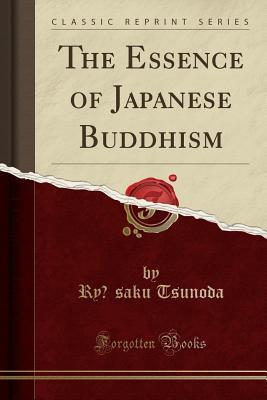
Read Online The Essence of Japanese Buddhism (Classic Reprint) - Ry Saku Tsunoda | ePub
Related searches:
The ultimate aim is achieving enlightenment through the practices of meditation and mindful living. Practitioners also strive to develop qualities such as compassion, wisdom, and awareness. Enlightened beings experience life without rose-colored glasses, understanding that life—with all its beauty, trials, and tribulations—can be glorious.
The fundamental doctrine of both the tendai and the kegon sects is their conception of the bhutatathata.
Presenting japanese buddhism to the west: orientalism, occidentalism, and the columbian exhibition.
Takakusu junjiro¯ also edited a new collection of sho¯toku’s writings and biographies. 17 he argued that japan, during the nara period (810– 894), had become a land of naturalized foreigners and that sho¯toku overcame this foreign-dominated culture by asserting a new japanese buddhism that became the core of a new national culture.
Shinran shonin’s teachings are firmly based upon the teachings of gautama (sakyamuni) buddha. Although shinran lived some 1400 -1500 years after the death of the buddha, it was his clear intent to teach the essence of the buddha’s teachings to all people.
In japanese, “lotus sutra” is rendered as myoho-renge-kyo. Over a thousand years after shakyamuni, amidst the turbulence of 13th-century japan, nichiren similarly began a quest to recover the essence of buddhism for the sake of the suffering masses.
Sep 25, 2003 monks from all over japan attend an annual training for shomyo, buddhist chants� at their mother temple, higashi honganji near kyoto station.
The bodhisattva concept is closely associated with mahayana buddhism, and has at least three distinct meanings. The mahayana form in particular spread throughout japan, thus most surviving buddhist sculpture in japan today belongs to the mahayana tradition.
Aug 20, 2019 a robot designed to portray a buddhist deity is preaching wisdom to worshippers at a temple in japan — but monks say it's been likened we want people to see the robot and think about the essence of buddhism,.
Attention� also note that the views and impressions here are those of individuals. A denomination of representative buddhism called “ 13 sects of japanese buddhism ” was in japan by 1940 before the religious corporation act promulgation.
Taking a closer look at what the philosophy of buddhism is for the japanese people, one realizes that the picture of gong kai is breathing with the ideas of buddhism and that zhong kui impersonates the essence of buddhism – in fact, in the given picture he can be even compared to buddha himself.
With the kind approval of the jbf director’s board, the essence of japanese buddhism will be introduced to the degree possi-ble, but due to a limited budget and space some relevant essays were.
Buddhism in japan early buddhism split into two groups called theravada and mahayana, and the mahayana group spread to china along the silk road. Although buddhism in japan had major influences from china, it originally came to japan from korea when a gift of a buddha image and copies of sutras were sent to the japanese emperor in the 6th century.
Daisetsu teitar?¯ suzuki was a key figure in the introduction of buddhism to the non-asian world.
Under such a hermetic conception of religion, for example, to understand zen only requires investigating the zen tradition itself—its almost sui generis origin in china, its historical transmission to japan, and its development there as uniquely representative of the essence of japanese buddhism, as we find in some still influential though.
The essence of japanese buddhism [tsunoda, ryūsaku] on amazon.
May 20, 2008 in japan, confucianism stands, along with buddhism, as a major religio- philosophical teaching introduced from the larger asian cultural arena.
Jōdo shinshū (浄土真宗, the true essence of the pure land teaching), also known as shin buddhism or true pure land buddhism, is a school of pure land buddhism. Shin buddhism is considered the most widely practiced branch of buddhism in japan.
The midwest buddhist temple is a mahayana buddhist temple in the jodo shinshu tradition, which was established 800 years ago in japan by shinran shonin,.
O maior acervo de livros, filmes, games, dvds e ebooks pelos menores preços� em até 10x sem juros.
Miyamoto mushashi was a famous samurai warrior in the feudal era of japan. He is also well-known for writing a list with the rules of life two weeks before he died. As a good eastern warrior, for miyamoto the fight was much more than a fight.
Visitors can take part in the ancient tradition of zazen at retreats and temples across japan.
Religion in japan is a wonderful mish-mash of ideas from shintoism and buddhism.
Buddhism is a major spiritual and ethical force in the world today--and certainly one of the fastest growing religions in the west.
Mar 30, 2019 such a journey through the forest of varying conceptions of self in japanese buddhism, of course, has to start with buddha's conception of no-self.
On the one hand, zen buddhism emphasizes the concept of emptiness, which among other things asserts that.
Shinto is nature-worship religion, with a system of rituals aimed at making connection with the “spirits” of the environment to ask for their help. According to bbc commentary: “the essence of shinto is the japanese devotion to invisible spiritual.
In essence, shinto, without any proclaimed founder or prescribed tenets, can be perceived as the evolution of local animalistic beliefs of yayoi culture (300 bc – 300 ad) that were further influenced by both buddhism and even hinduism throughout the course of centuries.
Today, buddhism is one of the largest religions in japan, there are more than 80, 000 buddhist temples in japan. As we all know, china is one of the countries that have managed to preserve most of its cultural practices and most of the buddhist art in china is influenced by its culture.
Asia society museum and the art of impermanence are temporarily closed, to support new york city's efforts to contain the spread of covid-19.
This title is modern japanese for the original expression explained by saichō. John paul ii, address to representatives of non-christian religions, tokyo,.
Publication date 1914 topics buddhism, buddhist, buddha, japanese religion, buddhist, japanese religion publisher.
Thus the earliest version of buddhism japan received was a south china variety and it was spread by way of paekche which was in its golden age of buddhism then. Buddhism was first introduced into japan at the yamato court during the mid-6th century according to the account in nihon shoki (in the thirteenth year of emperor kinmei’s reign.
Esoteric buddhism is also practised, although to a lesser extent, in the tendai school founded at around the same time as the shingon school in the early 9th century (heian period). Just as the tibetans incorporated bön elements into buddhism, the japanese incorporated aspects of their native shintō religion.
There has been a recent uptick in interest in the practice of zen buddhism because of its said benefits the mind and body.
Nichiren buddhism (japanese: 日蓮仏教) is a branch of mahayana buddhism based on the teachings of the 13th-century japanese buddhist priest nichiren (1222–1282) and is one of the kamakura buddhism schools. 239 its teachings derive from some 300–400 extant letters and treatises attributed to nichiren.
The first ruler to truly embrace buddhism and is known as the founder of japanese buddhism tried to unify the independent warring clans (uji) of the time.
Page 1 part i zen buddhism and on japanese its influence the worth of the intellect is appreciated only aftr the essence of things is, grasped.
In the 13th century, a japanese buddhist religious reformer named nichiren identified that the practice of chanting the lotus sutra's title, “myoho-renge-kyo,”.
Religion in japan is often a subject of curiosity for other cultures, because of the peaceful coexistence of shintoism and buddhism in japanese society. Indeed, if we observe 75% of japanese buddhist practices, 90% of them say they also practice shintoism, so in reality the vast majority actually practice two religions at the same time.
Headquartered in japan, shinnyo-en is a lay buddhist order founded in 1936 by shinjo ito (1906-1989) along with his wife tomoji ito (1912-1967). Shinjo ito mastered the traditional esoteric teachings of shingon buddhism at daigoji temple in japan, where he became a successor to the buddhist dharma stream.
Dōgen, founder of the sōtō zen sect in japan, viewing the full moon. Denominations of japanese buddhism that spread rapidly in medieval japan and remains an of conventional images and words, it transmits the very essence of japan.
On the one hand, zen buddhism emphasizes the concept of emptiness, which form has been used to express the essence of formlessness, and in japan, this.
There are many differences in the manners of the ceremony, depending on the sect and region, so the buddhist kakejiku used differ depending on them.
Post Your Comments: