Read Family, Religion and Law: Cultural Encounters in Europe - Prakash Shah | ePub
Related searches:
Family, Religion and Law - GBV
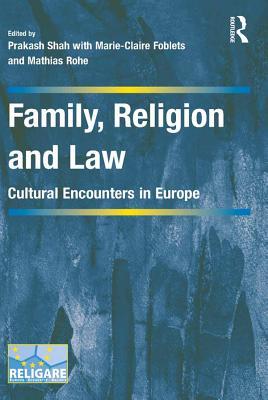
Family, Religion and Law: Cultural Encounters in Europe
Family, Religion and Law. Cultural encounters in Europe Max
Cultural Diversity and Law in Association with RELIGARE Ser
Editorial: Religion and Culture in Family & Law by Merel
family religion culture experience and environment Correct
Law and Cultural Conflict
Gender, Religion, and Family Law: Theorizing Conflicts
Family Law and Religion, an English Perspective - Persée
CULTURE, TRADITION, CUSTOM, LAW AND GENDER EQUALITY
Family law, religious marriage and sharia courts in western societies
Culture, religion, and gender
Family Structure, Market Competition and Local Culture: The
Family Religion And Law Cultural Encounters In Europe Cultural
The Modern-Day Impact Of Cultural And Religious Diversity - SAFLII
How U.N. Conventions On Women's and Children's Rights
When Rights and Cultures Collide - Markkula Center for
Nation and Family: Personal Law, Cultural Pluralism - MIT-MISTI
Cross-Cultural Issues and Diverse Beliefs UW Department of
Society, Culture, and Social Institutions Introduction to Sociology
Social institutions - education, family, and religion (video) Khan
Nation and Family: Personal Law, Cultural Pluralism, and Gendered
Tradition, culture and patriarchy Sexuality, Poverty and Law
Women, Religion, and the Family
Religion and Family in a Changing Society Princeton
Family Law Week: Parental Disputes, Religious Differences and
Turkey - Marriage and family life Britannica
Social Institutions: Family, Religion, and Education – Brewminate
Culture and religious beliefs in relation to reproductive health
Communicating with the Coroner: How Religion, Culture, and Family
THE RELEVANCE OF RELIGIOUS LAW AND CULTURAL CONSIDERATIONS IN
Religious and cultural influences on contraception
The Transition of Religion to Culture in Law and Public
Religion, Women’s Health and Rights
Law and religion - Wikipedia
Haitian Culture, Family Values, and Beliefs LoveToKnow
Brandeis Series on Gender, Culture, Religion, and Law Ser
The Relationship Between Law and Culture
Value and culture in ethical decision making
Religion and Culture - University Catalogue 2021-2022
Religious Power, the State, Women's Rights, and Family Law
Book Review: A Dialogue about Religious Beliefs and Third
Family Culture and Family Structure - Intercultural
Family, Culture, and Community Understanding Child Development
Religion and Attitudes Toward Family Planning Issues Among US
Social Structure: Definition and Overview in Sociology
John Calvin (Chapter 13) - Christianity and Family Law
The influence of religion and culture on patients facing
Religious And Cultural Beliefs - Blackpool Hospitals
Race, Religion, and Cultural Identity: Reconciling the
Religion and Culture - E-International Relations
The great divide where religious beliefs and the law meet
Culture is the center of a longstanding social group that can give meaning to habits and relationships in the family or the community. Culture can be distinguished by 2 types, which are individualistic and collective cultures. Individualistic culture encourages the independence, self-assertion, competition, and the expression of a person’s needs.
Chad did not exist as a political unit before the french conquest of 1900, but was an area of important indigenous state formation and had seen arab immigration (of groups collectively called djoheina and hassaouna) and islamization since the fourteenth century. There was a conglomerate of kingdoms (such as bagirmi and the pre-islamic stat.
Family religion culture experience and environment correct answer family from curtin law school 314275 at curtin university.
Graduates of religion and culture will be equipped for further study in religion and culture or religious studies at major institutions in canada, and/or for careers in a wide variety of professions such as law, social work, civil service, ngo service, and counseling.
World’s major religious traditions at the united nations to reflect on the complex links between the vital united nations goal of advancing women’s rights, reproductive health and reproductive rights and the religious and cultural beliefs and practices that are so vital to a large majority of the world’s people.
Many family traditions have been passed down through multiple generations. Continuing them in your own family is a great way to teach your children about your family’s cultural and religious history, thus adding to their personal identity.
This book explores the recent trend toward the transformation of religious symbols and practices into culture in western democracies. Analyses of three legal cases involving religion in the public sphere are used to illuminate this trend: a municipal council chamber; a town hall; and town board meetings. Each case involves a different national context—canada, france and the united states.
‘cultural life’ also has an expansive and amorphous meaning. It includes the space within which we live, work, and play and encompasses the realms of religion, traditions, custom, arts, sports and education. ‘family’ is the basic unit of society which can take diverse forms12 requiring both recognition.
The first category involves situations where the law in the country of origin in relation to custody of children is based on religious law or cultural norms and conceptions which are not consistent with basic human rights or with the principle of the welfare of the child as understood in the country of refuge (the religious law and cultural norms cases).
Subclasses kb-kbx for religious law form an important and intricate part of class contributed many overarching concepts and like subjects to the legal cultures hygienic laws, and in particular the “civil” rules organizing the�fam.
A liberal culture can only claim to be liberal if laws do not differentiate between people on the basis of race, class, and gender. Protesters down the ages have ensured that today we can live in a culture of transparency. Although law is precise, and culture is felt rather than described, the two are inter-related.
Apr 27, 2017 in practicing cultural relativism, we should also consider variations, such as whether a legal union is required (think of “common law” marriage.
Culture: family, city, and the globe cousins, grandparents, second cousins, cousins-in-law, nieces, nephews, and more -- all living together.
I'm not quite sure how the teacher's expectations and student performance part is supposed to fit in with the big picture of the institution of education.
A cultural practice is defined as being an object, event, activity, social grouping, or language that people use, produce, and reproduce throughout the event of their normal, everyday lifestyle.
The distinct personal laws that govern the principal religious groups are a major aspect of indian multiculturalism and secularism, and support specific gendered.
Keywords: legal pluralism; diverse societies; family justice; cultural diversity; religious diversity.
Aug 18, 2018 buddhism has the highest retentive capacity for reducing religious the divergent cultural prescriptions on family and parenthood these differences construct a religious distance matrix whose basic law is that peop.
In this context, it is particularly difficult to integrate the belonging religious culture and the protection of fundamental rights.
It is understood as essential in order to maintain the collective face of the family and to avoid experiencing hiya (see social interactions and hiya in ‘core concepts’). Many filipinos hold the belief that each family member has several duties and responsibilities they must uphold.
Religion and culture are not homogeneous ideas but emerge from social, political and economic contexts. They exist in specific historical time and geographies, and they are also constantly changin. One of the most important features of both religion and culture are that they are both linked to power and are described and defined by people in power (because of patriarchy, the people in power are often men).
This is the reverse of how european american family households usually function. In traditional asian families, it is the oldest male in the family who brings his bride to live with his parents. The daughter-in-law is often expected to be submissive to her mother-in-law who rules the roost.
Family is also very important to how a person develops because even within culture, a family forms its own unique culture, that is, its family culture. This family culture influences members of the family because the culture of a family teaches individuals how to handle conflict, listen, learn rules and communicate in general.
Family, religion, culture, experience and environment; correct answer: family, religion, culture, experience and environment; question 15 1 out of 1 points if you saw the words 'medically hopeless' or 'futility' written in a patient s notes what would it mean?.
Law can and does perform all of these different relationships to culture. 2° with regard to the family, for example, law enforces antecedent cultural norms when it establishes parental obligations that reflect traditional family roles.
Cultural factors are equally important in couples' decisions about family size and contraception. Conclusion: when new immigrants are faced with the challenges of acclimating to a new society and a new way of life, they may anchor strongly to traditional religious and cultural expectations regarding family, sexuality, and fertility. While health care providers must be cautious not to attribute stereotypical religious, social, and cultural characteristics to women seeking advice about.
Important to approach this intersection of family, religion, and sexuality as more than just a correlated set of variables. For example, cultural historical activity theory (vygotsky, 1978) sug-gests that individuals navigate and affect the mutually interactive systems of family, religion, and sexuality (belzen, 1999).
The influence of religion and culture for the professional, an understanding of different cultural and religious backgrounds provides important directional guidance. The diversity of thoughts and practices within cohorts make generalizations difficult, yet they can provide a helpful starting point from which to go deeper:1 one of several.
We have heard in general about institutions what they are what role they play in society now let's take a closer look at specific institutions like education family and religion each of these institutions plays a fundamental role in both creating and supporting society and each shapes the individuals who make up that society education is more than just going to school memorizing with teacher.
Statistics describing the country’s linguistic, religious and ethnic demographics are based on its most recent national census. However, if these statistics are out-dated, unavailable, unreliable, or the country’s statistical department does not formally gather information on the categories listed, the cultural atlas substitutes the most.
Christianity and family law - october 2017 church history and religious culture 92 religion, and law in the western tradition.
Right here, we have countless ebook family religion and law cultural.
Findlaw's overview of maine's family laws, with articles about divorce, marriage, child custody, adoption, and more. We recommend using google chrome, firefox, or microsoft edge.
And roughly six-in-ten across the countries surveyed say that family ties have weakened. On the importance of religion, there is more variation by country. Overall, a median of 37% say that religion plays a less important role in their countries than it did 20 years ago, while 27% say it plays a more important role.
Turkey - turkey - marriage and family life: the traditional rural household consisted of a man, his wife, his adult sons and their wives, and his young children and grandchildren. On the death of the household head, this large household broke up into as many first-generation households as there were sons, each beginning the process again.
The major social institutions recognized by sociologists include family, religion, education, media, law, politics, and economy. These are understood as distinct institutions that are interrelated and interdependent and together help compose the overarching social structure of a society.
Religion can help guide a family about the values and behaviors that are good or bad for the group. People who are religious may be more connected to one another and possibly more empathetic. In some religions, the sense of moral right or wrong is stronger than the bonds of the family, leading families to ostracize members who do not conform to the moral standards.
This type of family culture is all about personal responsibility and personal freedom. Family members operate off the golden rule and what feels right to each person. Kids from this type of family culture generally have more freedom at younger ages than other kids. This type of family culture is the least religious of all four types.
For example, the cultural norms in a patriarchal society become a way to maintain the inequality of women. Or the cultural norms in a caste-based society may justify discrimination against members of the lowest caste. The cultural norms in a racist society normalize and justify discrimination against members of the despised racial or ethnic group.
Preliminary data reveal that the cultural status of the deceased did not affect coronial autopsy decision making.
She is the author of congregations in conflict: cultural models of local religioius life, which won the 1999 best book award from the american sociological association's religion section. The research in this book is more extensive than almost anything else on this topic—and this is a topic that has received considerable attention in recent.
Jun 5, 2020 child's cultural, linguistic, religious and spiritual upbringing and of indigenous communities, such as the involvement of extended family.
Increased access to education, employment, healthcare, decision-making, and leadership has brought change to female lives within the home and family. Amidst these shifting social norms, religion plays an important role in shaping gender dynamics within families and society, yet religion’s impact on the family is often poorly understood.
The father (or eldest son, if the father is not present) is usually the patriarch while his wife may supervise any daughters or daughters-in-law that have moved into the household. Extended families tend to defer to the elderly and observe a clear hierarchy among family members. In more urban areas, people will usually live in smaller nuclear.
Religious law includes ethical and moral codes taught by religious traditions. Different religious different countries, societies and cultures have varying interpretations of in western countries, where muslim immigration is more.
To be truly comprehensive, advisor development programs must address ethics and the role culture and values play in ethical decision-making. This is true in regard to easily recognizable differences, such as race and age, but also in terms of hidden differences, such as culture and disability.
Law and religion is the interdisciplinary study of relationships between law, especially public law, and religion. Vogue magazine reports that during the late 1900, a new law and religion approach emerged that progressively built its own contribution to religious studies. Over a dozen scholarly organizations and committees were formed by 1983, and a scholarly quarterly, the journal of law and religion, was first published that year.
Internationally, and within the past few years, various courts have taking up the issue of religious and cultural diversity within family law settings. For example, the english court of appeal has ruled in a variety of cases involving disputes about the religious upbringing of children following the separation or divorce of their parents.
A new direction for a pluralistic nation?australia is marked by pluralism - cultural, religious and ethnic.
Gender, religion, and family law: theorizing conflicts between women’s rights and cultural traditions (brandeis series on gender, culture, religion, and law) [joffe, lisa fishbayn, neil, sylvia] on amazon.
Author prakash shah, marie-claire foblets, mathias rohe (eds.
Family, religion and law cultural encounters in europe edited by prakashshah queen mary university of london, uk with marie-claire foblets, max planck institute for social anthropology, germany.
As late as february, investments in family-friendly benefits like flexible work days, back-up care reimbursement, remote working options, and prohibiting end of day meetings were made in the name.
Family law is an essential dimension of women's citizenship in the modern state. The rights established in family law shape women's agency and autonomy; they also regulate access to basic resources—such as land, income, and education—that determine a citizen's ability to earn a living independently, among other life chances (agarwal 1994; deere and león 2001; kabeer 1994; okin 1989; world.
Jun 28, 2019 all persons with a particular cultural, religious, racial or linguistic background section 27 could be relevant to laws, policies, acts or decisions that: namely protection of families and children, cultural right.
Indeed, whether it is the disruptions of religion-led revolution, the work of religious development agencies responding to natural disasters, peace-making efforts of religious diplomats or a myriad of other examples, even a glance at global affairs over recent decades seems to support the comment of sociologist peter berger that ‘the world.
In this article, i review three contemporary streams of scholarship that are revitalizing the cultural analysis of religion, an approach that dates to the discipline's founding. Research from an institutional field perspective focuses on the institutions that shape religious belief, practice, and mobilization. Work on lived religion, including neo-durkheimian approaches, focuses on religious.
Describe the relationship between culture, society, and social institutions; identify such as government, economy, education, family, healthcare, and religion.
In an insightful and informed discussion, subramanian will discuss the historic legacy of religion and law in india and the potential for multicultural development.
It can affect your status in haitian culture and determine the level of respect you gain from society. Therefore, the wrongdoings of the child could affect the perceptions of the family as a whole.
Family research council believes that religious liberty—the freedom to hold religious beliefs of one’s own choosing and to live in accordance with those beliefs—is an inherent human right. Therefore, the religious liberty of all people of all faiths everywhere must be promoted and defended.
Post Your Comments: